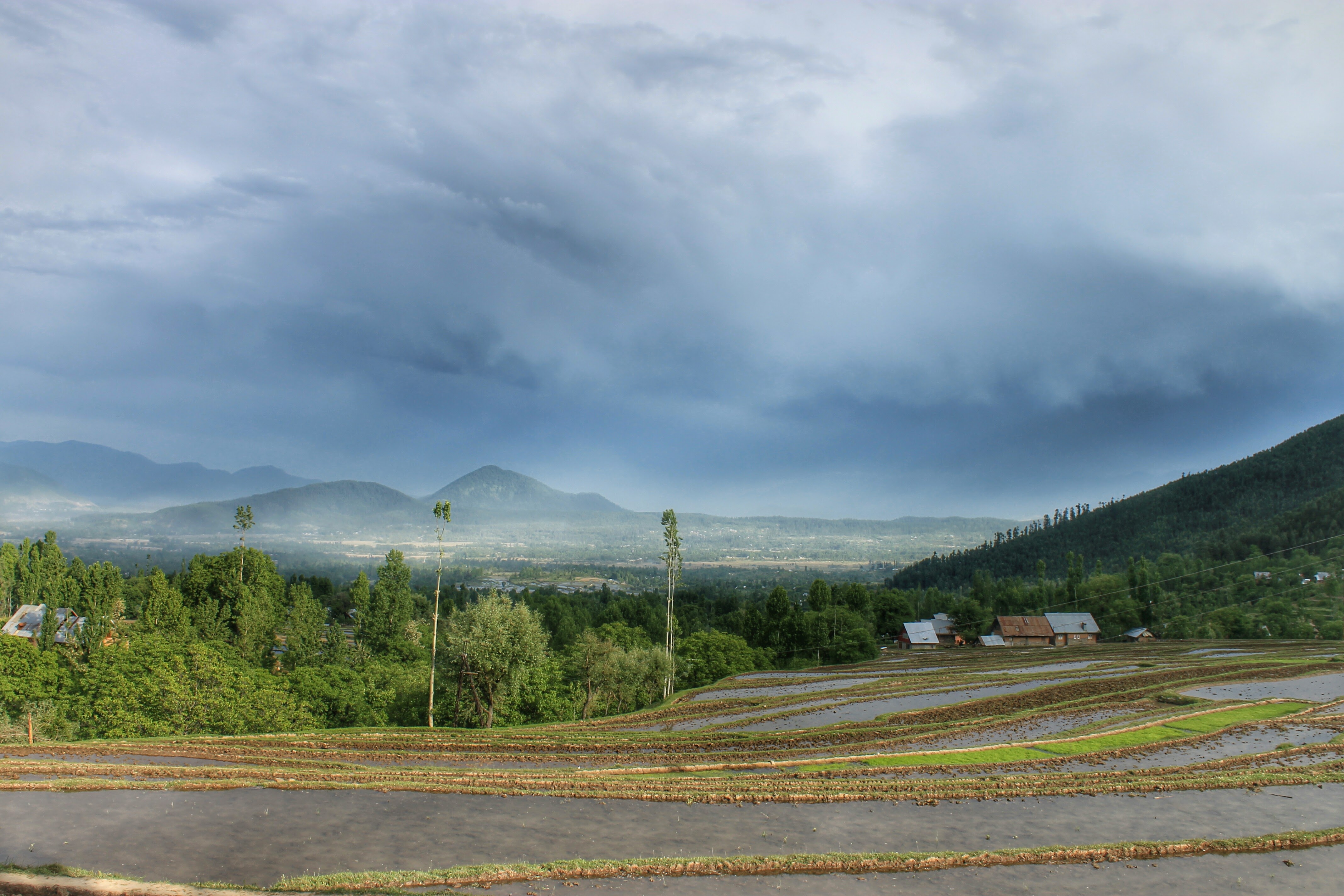
The rapid conversion of agricultural land for roads, railways, commercial property, and housing in Kashmir Valley is accelerating, threatening livelihoods and food security. This shift, driven by development and urbanization, has dramatically reduced areas under staple crops like paddy and increased reliance on imported food grains. Once fertile paddy land is converted for commercial or non-agricultural purposes, a house, a complex, or even a small shop, it is permanently lost to cultivation. Such transformations, as experience and date shows, are irreversible. Several farmers I met during my research spoke of how dramatically the landscape around their villages has changed over the past two decades. The once-continuous stretch of paddy fields has been slowly consumed by houses, shops, and construction sites.
People need land to build homes, says M. Shaban, a farmer from Budgam. The demand for plots has grown over the years. Most families from the villages near Srinagar airport have now spread across what used to be our green paddy fields
This demand, rooted in population growth and aspirations for urban life, is real, yet it comes at the cost of fertile soil that once sustained generations.
The neglect of canals systems
Dr. Bashir Veeri, a sitting MLA of the ruling J&K National Conference from Bijbehara in Anantnag, moves through the villages of his constituency, stopping at road construction sites and meeting residents in remote Scheduled Tribe settlements. We walk together through apple orchards heavy with late summer foliage. He gestures toward a narrow stream cutting across the fields—the Dadi Canal, built during the Dogra rule—its flow shallow, uneven, almost hesitant. From there, he speaks of another canal, far older and once far more consequential: the Nandi Canal. Developed in the fifteenth century under Sultan Zain-ul-Abideen, locally known as Badshah, the canal was built on the encouragement of the Sufi mystic Sheikh-ul-Alam (Nundresh), who urged local farmers to create a system that could sustain their fields and livelihoods. Branching from the Veshov, a tributary of the Jhelum, the Nandi Canal stretched nearly eighteen kilometres and once irrigated around 2,000 hectares of farmland across more than twenty-four villages in Anantnag and Kulgam—an area long known as the rice bowl of Kashmir. With a carrying capacity of 6.64 cubic metres of water per second, it was among the most significant irrigation systems of its time.
Today, the canal stands on the brink of collapse. Its embankments are choked with garbage, its flow weakened by illegal riverbed mining and unplanned concretisation, leaving downstream villages in chronic water shortage. Dr. Muzaffar, an environmental activist, says mining in the Veshov Nallah has drastically reduced water flow, damaging the canal’s natural retention system. “Leakage, overflow, and seepage,” he explains, “show the complete apathy of the irrigation department toward this historic canal that once sustained life here.”
Dr. Veeri shares this frustration.
You cannot execute any developmental or infrastructural project without the consent of the local population, he says. Yet they bypass the law, use force, and compel people to accept compensation for land taken for roads and highways. It is a shameful act of dispossessing; an attack on the soul of this community. And that soul is its agriculture.
Walking along the broken banks of the canal, it becomes clear that the story of water in Kashmir is no longer just about irrigation. It is about control. What once flowed freely through the veins of this land now stumbles under the weight of neglect, bureaucracy, and the machinery of ‘development’. The expanding web of highways across South Kashmir cuts through what was once the valley’s rice belt, altering not just the geography but the circulatory system of its water. Traditional canals that once carried life into the fields now lie clogged with silt and refuse, drowned out by the noise of excavators. Each new ‘upgrade’ erases something older and quieter—systems that worked, even if imperfectly. Canals that fed rice paddies. Karewas that held moisture and grew almonds. Flattened, excavated, built over, sacrificed for the next project report. In the name of progress, networks of survival built by hand, managed through trust, and sustained over centuries are being dismantled piece by piece. The shift is subtle, almost bureaucratic in tone, but visible in every field: from community-managed irrigation to state-managed construction; from water that fed crops to asphalt that feeds an economy of contracts, tenders, and clearances. Beneath it all, farmers stand at the edges of drying canals, watching their crops wilt, uncertain whether the next project will restore water or take what little remains.
Water-sharing in Kashmir was never merely technical; it was social, even sacred. I come from a village that hosts three irrigation canals, each feeding fields across dozens of villages downstream in Budgam. Water meant responsibility. I remember men; young and middle-aged gathering in our local mosque after evening prayers, carrying torches or kerosene lamps, taking turns to guard the flow through the night, ensuring each village received its share in time. There was order in that rhythm, a quiet cooperation that kept the land alive.
Quiet Before the Road:
The consequences of this shift are visible even before construction begins
On my way to Nowgam, a quiet village in Kashmir’s Shopian district, I pulled over to ask a question. Word had spread that a road was being planned through the heart of the village’s apple orchards; orchards that have sustained families for generations. As I rolled down my window, two men leaned in, assuming I was some government official.
I asked whether any demarcation signs had been placed by the National Highways Authority of India, or if construction had begun. Both shook their heads. “No signs, no work yet,” one of them said. Then, almost casually, they added that most landowners had already received compensation a few months earlier.
When I asked if anyone had objected, they exchanged a brief smile.
Who would say no? one of them asked. Even if the project doesn’t serve the community, when the government decides, it decides. It’s safer to stay quiet and accept what’s offered.
A few kilometres ahead, a red concrete demarcation pole stood awkwardly inside an apple orchard. I stopped, slung my camera over my shoulder, and walked in. A man stood nearby, grazing a single sheep—likely for Eid sacrifice.
I asked if I could enter. He nodded.
“Is this your land?”
Another nod.
“Did you receive any notice before this was marked for the NH-444 expansion?”
“No,” he said. “Nothing at all.”
He recalled a winter day when a group of men arrived to conduct a survey, drones buzzing above them. When villagers asked questions, they were told the road above the orchards would be widened. Later, officials from the Horticulture Department arrived, explaining that compensation would be paid for the apple trees that would soon be cut. For now, farmers are allowed to continue cultivating their land—this summer may be their last. Around forty households are expected to lose their orchards, often their only source of income. In Nowgam, the road is not yet built. But its presence is already felt—as a line drawn through livelihoods, choices, and a silence shaped by inevitability.
 Sajad Rasool