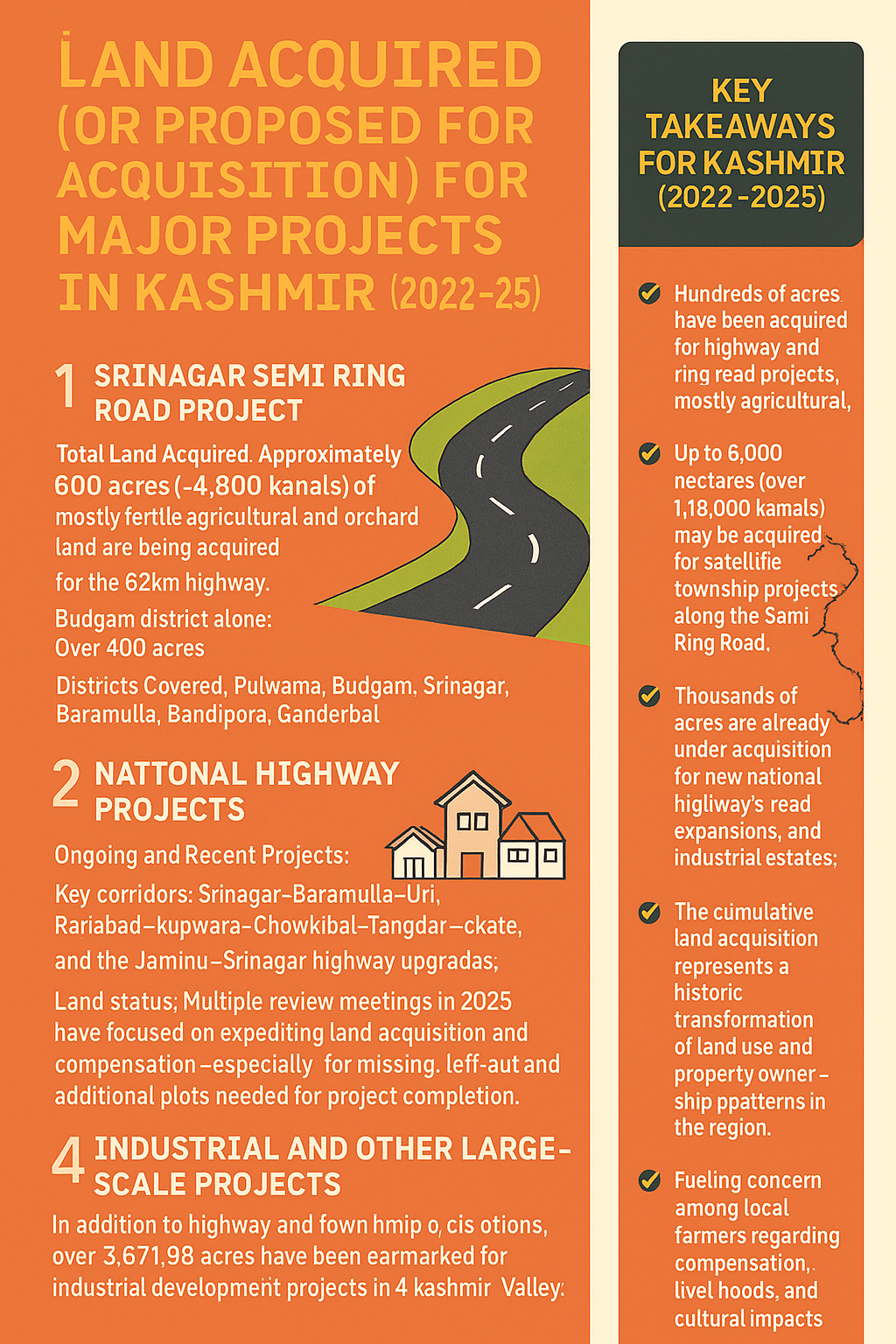
Through this blog, I try to capture this collision: the voices of farmers watching their land vanish, the memory of customs like Gangul that rooted us (Kashmiris) in the soil, and the stark reality of how political control often begins with the control of land. To speak of Kashmir’s land is to speak of its people, their identity, and their survival.
At the heart of this inquiry lies a haunting question: “Kus kari Gongul?” — Who will sow? This is no longer just a seasonal invocation of fertility, but a question about the future of Kashmir itself.
- Farmers’ Voices: In intimate conversations, farmers recount how their orchards, fields, and meadows are acquired, fenced, or demarcated without their consent. Their testimonies reveal not only economic loss but the emotional rupture of being severed from ancestral soil.
- Changing Landscapes: The valley’s physical geography is transforming before our eyes—green orchards replaced by grey highways, wetlands drained for housing colonies, glaciers carved by road-building machines. These visual shifts in the land are not neutral progress; they are evidence of systematic dispossession.
- Land Laws (and their violations): The post-2019 legal regime has opened Kashmir’s land to outside ownership, often in direct violation of protections that once safeguarded local farmers. These laws, altered or bypassed, reveal how the machinery of governance itself becomes a tool of displacement.
- Surveillance and Restricted Speech: Farmers who resist or raise questions face constant watchfulness—surveys, drones, and census-like exercises that catalog their lives. Freedom to speak, protest, or even publicly mourn the loss of land is tightly restricted, ensuring silence in the face of transformation.
- Corporate Expansion: New industrial policies and corporate acquisitions have shifted control of fertile tracts from cultivators to large private players. Agriculture, once a community-driven economy, is being restructured under corporate interests that rarely serve the farmer.
- Religious Tourism and Demographic Engineering: Alongside corporate control is the aggressive promotion of Hindu religious tourism projects, often built over fragile ecologies and agricultural spaces. Pilgrimage routes and facilities expand into meadows and forests, turning sacred landscapes into contested zones of identity and control.
- Climate Change: Farmers also confront the undeniable signs of climate shifts—cloudbursts, erratic snow, shrinking glaciers, and declining crop yields. These changes exacerbate the precariousness of farming, threatening Kashmir’s agrarian future from within as much as external forces do from without.
- Resilient Methodologies: Yet, amid these challenges, resilience endures. Farmers continue to adapt, organize, and resist. Through my work, I engage in workshops on land laws, training in visual evidence collection, and community dialogues aimed at empowering farmers with knowledge and tools to defend their rights. These small acts of resistance—archiving, educating, documenting—are attempts to keep alive the possibility of sowing again.
Thus, the question “Kus kari Gongul?” is both a lament and a call to action. Who will sow, when the land itself is under siege? Who will sow, when fields become highways, orchards become concrete, and glaciers melt into rivers of loss? And yet—who will sow, if not those who refuse to surrender, who still believe that to till the soil is to claim both dignity and survival?